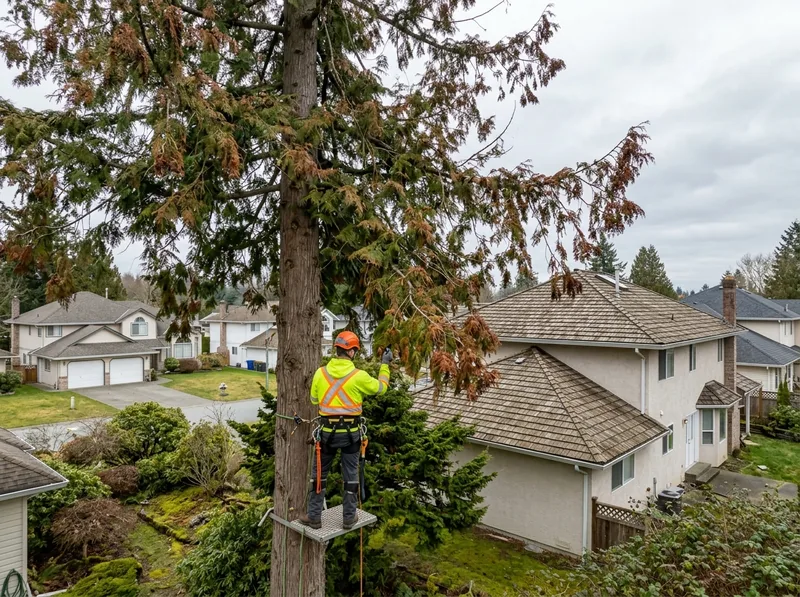




Western redcedar across the Lower Mainland has been thinning and browning from the top down after successive dry summers. A Western Redcedar Dieback Assessment in Surrey determines how far the decline has progressed and whether the tree is worth preserving or should be removed. Our ISA Certified Arborists evaluate crown density, branch mortality, bark condition and root vigour to guide your next steps. Many homeowners in Surrey neighbourhoods assume their cedars are dying when careful pruning and improved site conditions can restore them. We assess the full picture and give you a clear path forward. Call us at (236) 707-6867 for a free estimate, or visit our tree disease diagnosis page to learn how we diagnose other common conditions.
Why Western Redcedar Dieback Assessment Matters in Surrey
Cedar decline is not a single disease but a stress response to drought, soil compaction, poor drainage and sometimes root damage from construction or landscape work. In Surrey and the surrounding area, late summers bring extended dry periods that push mature cedars to their limits. An assessment separates trees that will recover from those that have crossed the point of no return. Removing a dead or dying cedar before it fails prevents liability, opens sight lines and makes room for healthier species.
- We inspect the crown for live foliage density and colour, starting from the top.
- We probe the trunk and main branches to assess wood condition and detect internal decay.
- We examine the base and root collar for girdling, damage or pest entry points.
- We evaluate the site: drainage, soil compaction, grade changes and nearby construction history.
- We document findings in a written report with photographs and recommendations.
This methodical approach ensures you do not waste money on trees beyond saving, and do not cut down trees that will thrive with targeted care.
Local insight: In Whalley and other mature neighbourhoods across Surrey, cedars planted in the 1970s and 1980s now face cumulative stress from root-bound conditions and compacted clay soils. A dieback assessment often reveals that crown thinning is reversible if drainage and aeration improve.
How We Assess Your Cedar in the Surrey Area
Our assessment process combines visual inspection, hands-on probing and site analysis. We arrive with climbing gear, binoculars, a moisture metre and a sharp knife to test wood condition at multiple heights. We photograph the crown from all angles and note the pattern of dieback (top-down, tip-back, asymmetrical or uniform loss). We also ask you about recent changes: construction, grade fill, drainage problems or pest activity. The assessment typically takes 45 minutes to an hour, depending on tree size and access.
- We climb or use a boom lift to inspect upper crown branches that ground-level sight cannot reach.
- We test bark flexibility and wood hardness with hand tools to confirm whether cambium is still active.
- We measure crown density as a percentage of foliage-bearing branches to track decline severity.
- We collect soil samples and check drainage patterns around the root zone.
- We issue a written report within two business days with clear recommendations and cost estimates if action is needed.
If we recommend removal, we can provide a separate estimate for tree removal and stump grinding. If the tree is worth saving, we outline pruning and site improvement steps.
Real example: A homeowner in City Centre Surrey noticed her 18-metre cedar was brown on the east side. We assessed it and found the problem was not disease but grade fill that had buried the root collar by 30 centimetres during a recent patio installation. We recommended removing the fill, aerating the root zone and light pruning of dead branch tips. Two years later, the cedar has recovered full colour and density.
Assessment Methods and What They Reveal
| Assessment Method | What It Shows | When We Use It |
|---|---|---|
| Crown density mapping | Percentage of live foliage; identifies pattern of loss (top-down, asymmetrical, uniform). | All assessments; the primary diagnostic tool. |
| Bark and wood probing | Cambium activity, internal decay, insect galleries, wood colour and hardness. | When decline is advanced or we suspect hidden damage. |
| Root collar and base inspection | Signs of girdling, grade fill, root damage, pest entry or soil erosion. | Every assessment; often reveals the root cause of decline. |
| Site and drainage analysis | Soil compaction, water pooling, nearby construction impact, exposure to salt or wind. | When recovery is possible; helps us recommend corrective work. |
Each method feeds into a single conclusion: can this tree be saved, and is it worth the cost? We never recommend removal lightly, but we also do not encourage you to spend money nursing a tree that will decline regardless.
What Happens After the Assessment
Once we complete the assessment, you receive a detailed written report. If the cedar is salvageable, we recommend specific steps: crown cleaning (removal of dead branches), selective pruning to improve air flow, soil aeration, drainage correction or mulching. If removal is the best option, we provide a separate cost estimate and timeline. You are never obligated to hire us for follow-up work; the assessment stands alone and you can share the report with a contractor of your choice.
The City of Surrey may require a permit for a private tree removal, and an arborist report like ours supports that application. We can advise whether your situation likely needs a permit and help you prepare the paperwork. We also respect approach distances near private electrical service entrances and never work on the public distribution network of BC Hydro.
If you decide to proceed with pruning or removal, we handle all debris removal and site cleanup. Wood chips are hauled away or chipped on-site for mulch. Stumps can be ground down to below-grade, leaving the site ready for replanting or landscaping. Learn more about our tree pruning and crown reduction service or our wood chipping options.
When to Schedule an Assessment
You do not need to wait for spring or summer. Dieback is visible year-round, and winter is actually an ideal time because deciduous trees are bare and the cedar's condition stands out clearly. If your cedar is showing brown foliage, branch tip dieback, or a noticeably thinner crown than it had two or three years ago, contact us now. The longer you wait, the more branches may die and the fewer recovery options remain. We offer same-week appointments for assessments in most cases.
Call Fraser Ridge Tree Trimming at (236) 707-6867 to book your free estimate. We serve Surrey, White Rock, Delta, Langley and the surrounding communities. Our ISA Certified Arborists will visit your property, assess your cedar thoroughly, and give you honest advice on whether to save it or remove it. No pressure, no sales pitch, just straightforward expertise grounded in 12 years of work across the Lower Mainland.
Prices Western Redcedar Dieback Assessment in Surrey — Indicative pricing
| Service | Price | Details |
|---|---|---|
| Western Redcedar Dieback Assessment | From $225 | Comprehensive crown inspection, wood probing, site analysis and written report with photographs |
| Assessment plus recommendations | From $325 | Includes detailed care plan or removal estimate if action is needed |
| Large or complex property | On estimate | Multiple cedars, difficult access or extensive site work assessment |
| Travel and site visit | Included | In Surrey and the surrounding area |
| Free estimate | Always free | No obligation; response within 24 hours at (236) 707-6867 |
Indicative prices; free, personalized estimate within 24h at (236) 707-6867.