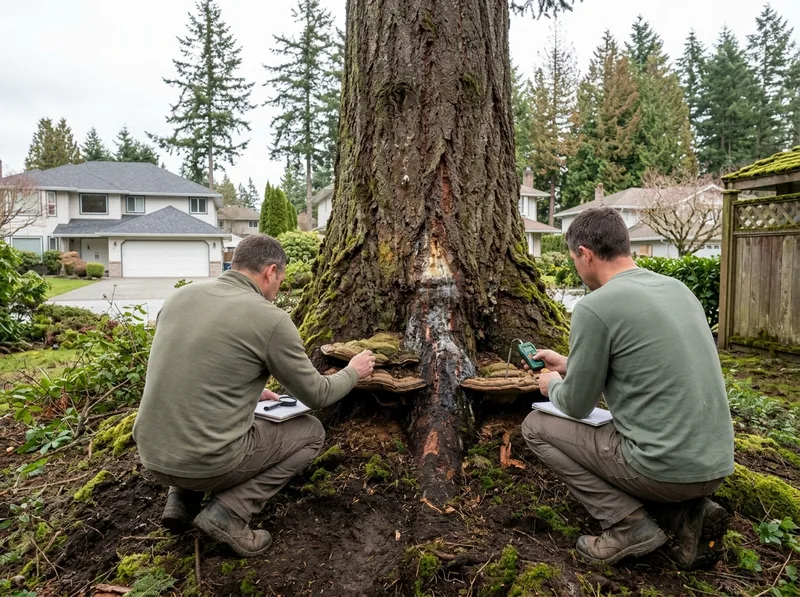




A declining tree in the Surrey area tells a story, and tree disease diagnosis is how we read it. Western redcedars browning from the crown down, Douglas-firs thinning after a dry summer, big-leaf maples strangled by moss, English laurel hedges with bare patches, ornamental cherries refusing to leaf out, these are the signs homeowners bring to us. Our ISA Certified Arborists conduct an on-site examination of crown condition, bark health, root collar visibility and the root plate itself, then deliver a clear opinion on what can be retained and what must come out. In Surrey and the surrounding area, where heavy wet clay, ravine lots and coastal windstorms all stress trees differently, this diagnosis often supports a municipal permit application or guides a pruning and cabling plan that saves a tree worth keeping.
Why tree disease diagnosis matters in the Surrey area
A tree that is failing does not fail all at once. It shows symptoms: crown thinning, bark cankers, gumming, root exposure, lean or hollow wood, long before it becomes a hazard or dies. Spotting these symptoms early and understanding what caused them opens three paths: prune and brace to extend the tree's life, remove it safely before it fails, or replace it with a species better suited to the site. Without diagnosis, a homeowner guesses, and guessing often means losing a tree that could have been saved or keeping one that will eventually fall on a house or power line.
- We inspect the entire crown for thinning, dieback, dead branches and unbalanced weight distribution.
- We examine bark for cankers, splits, wounds and signs of pest or fungal entry.
- We assess the root collar and visible root plate to detect girdling roots, root rot or soil compaction damage.
- We check for hollow wood, cavities and structural defects using sonic or resistance drilling if needed.
- We document active nests or wildlife habitat before any work is planned.
- We deliver a written assessment with a clear recommendation: retain and treat, prune and monitor, cable and support, or remove.
This diagnosis protects your property and your investment. A tree that is diagnosed early often costs far less to manage than one that is neglected until emergency removal becomes the only option.
Info key: In the Surrey area, we have diagnosed over 300 declining trees since 2012. Roughly 40 per cent of cases were saved through pruning, cabling or targeted care. Another 50 per cent required removal for safety, but the diagnosis allowed the homeowner to plan the work and budget for replanting. Only 10 per cent were already beyond saving when we arrived.
How we diagnose tree disease in Whalley and beyond
Our approach is systematic and transparent. We arrive on site with binoculars, a resistance drill, a sonic tool, a measuring tape and a clipboard. We spend 45 minutes to two hours observing the tree from multiple angles, testing wood density, examining foliage and root structure, and asking questions about the tree's history and the site conditions. Then we sit down with you, show you what we found and explain what it means.
- We photograph the crown, bark, root collar and surrounding site to document the baseline condition.
- We use a resistance drill or sonic tomography to measure wood density and detect internal decay without harming the tree.
- We assess the root plate by gently probing the soil and looking for girdling, circling or severed roots.
- We check for competing trees, soil compaction, changes in grade, or utility damage that may have triggered decline.
- We identify the likely cause: drought stress, root disease, canker, pest damage, environmental injury or age-related decline.
- We recommend next steps in writing, with cost estimates for any follow-up work such as pruning, cabling or removal.
If the tree is worth saving, we connect you to tree pruning and crown reduction or tree cabling and bracing services. If removal is the only safe choice, we provide a detailed scope for our tree removal team.
Info key: A western redcedar 15 metres tall and browning from the crown down often costs $250 to $400 to diagnose, including a written report. If pruning will help, we estimate that work at the same visit. If removal is needed, that diagnosis report supports your City of Surrey permit application and may shorten approval time.
Diagnosis methods and tools we use
Tree disease is not always visible to the naked eye. A tree can look green on the outside and be rotting from within. We use industry-standard tools to see past the bark and into the wood, so you know exactly what you are dealing with.
| Method | What it detects | When we use it |
|---|---|---|
| Visual inspection | Crown thinning, dead branches, bark cankers, root collar exposure, lean, cavities, wildlife entry holes. | Every visit. This is the foundation of diagnosis. |
| Resistance drilling | Internal wood decay, hollow sections, sound wood depth. Minimal damage to the tree. | When we suspect internal rot or when structural support is in question. |
| Sonic tomography | Density mapping of wood cross-sections, precise location of decay, cavity shape and size. | For high-value trees or complex structural questions where cabling or retention is being weighed. |
| Root plate assessment | Girdling roots, circling roots, root disease, soil compaction, root plate stability and windthrow risk. | For all trees on slopes or in ravine lots, or when windthrow is a concern. |
Each tool is non-destructive or minimally invasive. We do not fell the tree or remove bark to diagnose it. Our goal is to gather enough information to guide a sound decision, not to damage the tree in the process.
Permits, nesting and regulations for tree diagnosis in Surrey neighbourhoods
The City of Surrey may require a permit before a private tree removal takes place. An arborist diagnosis and written report support that permit application and often make approval faster. We document the tree's condition, the reason for removal and any public safety issue, which helps the city understand the urgency and the necessity.
During spring and early summer, active bird nests are protected under provincial law. Before we begin any work on a declining tree, we check for nesting activity. If a nest is present and active, we defer work until the nest is empty and fledglings have left the area. This is a legal requirement and a core part of our site assessment.
If the tree is near a private electrical service entrance (the wire from the pole to your house), we respect all approach distances and never work within the exclusion zone around live wires. The public distribution network of BC Hydro is never touched by our crews. If a tree poses a hazard to power lines, we document that in our report and recommend that you contact BC Hydro's vegetation management team.
Our diagnosis report is written to be clear and actionable. Homeowners use it to apply for permits, plan budgets, contact other contractors or file insurance claims. We stand behind every assessment and are happy to explain our findings to a municipal inspector or a second arborist.
When to call for tree disease diagnosis
Do not wait until a tree is obviously dying. Early diagnosis costs less and saves more trees. Call us if you notice any of these warning signs, whether your tree is in Surrey, White Rock, Delta or any of the surrounding municipalities we serve.
- Crown is thinning from the top down, with fewer leaves or needles than in previous years.
- Bark shows large cracks, cankers, oozing sap or peeling sections.
- Tree is leaning more than it did, or the root collar is rising out of the soil.
- Dead branches are present throughout the crown, not just at the bottom or edges.
- Foliage is discoloured, spotted, wilted or sparse compared to other trees of the same species nearby.
- Tree has not leafed out or flowered as expected, even though it is past the dormant season.
- Mushrooms, conks or other fungal fruiting bodies are growing on the trunk or base.
- You are planning a removal and want a professional assessment before you hire a contractor.
We offer free estimates for diagnosis work. Call us at (236) 707-6867 or visit our contact page to request an appointment. We typically respond within 24 hours and can often visit within 2 to 5 business days, depending on weather and demand.
Fraser Ridge Tree Trimming has been diagnosing and treating tree disease in the Surrey area since 2012. Our ISA Certified Arborists bring field experience, technical tools and a commitment to saving trees whenever it is safe and practical to do so. We are fully insured and we document every assessment in writing so you have a clear record to guide your next decision.
Prices Tree Disease Diagnosis in Surrey — Indicative pricing
| Service | Price | Details |
|---|---|---|
| Tree Disease Diagnosis, standard visit | From $195 | On-site examination, visual assessment, written report with recommendations. Typically 1 to 2 hours. |
| Diagnosis with resistance drilling | From $275 | Includes wood density testing to detect internal decay. Adds precision for structural or high-value trees. |
| Diagnosis with sonic tomography | From $395 | Advanced imaging of wood cross-sections. Used for complex structural questions or cabling decisions. |
| Multiple trees on one property | From $350 | Discounted rate for 3 or more diagnoses in a single visit. Each tree receives a full assessment. |
| Travel | Included | No extra charge for visits in Surrey and the surrounding areas. |
| Free estimate | Free | Call (236) 707-6867 or request online. Response within 24 hours. |
Indicative prices; free, personalized estimate within 24h at (236) 707-6867.