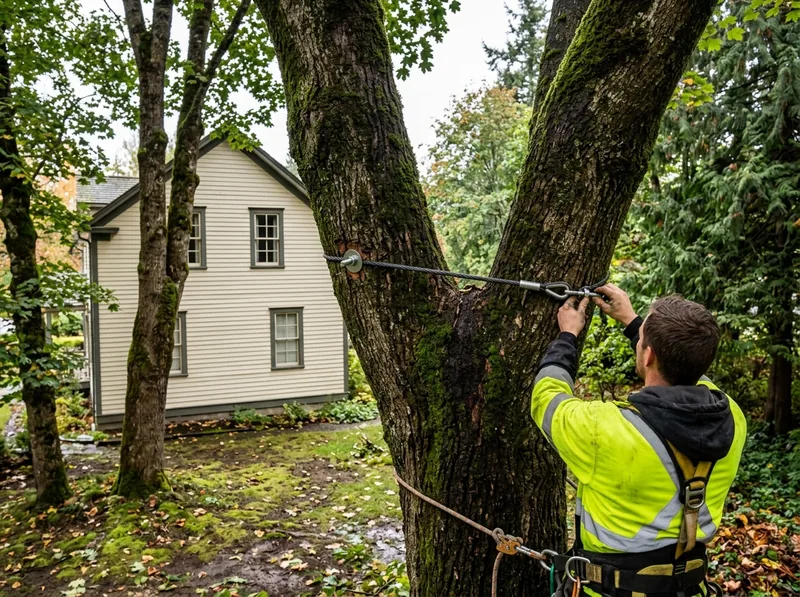




Tree cabling and bracing in Surrey protects mature trees with structural weakness, letting you keep a valued specimen rather than remove it. Trees with weak branch unions, included bark, or cracked scaffold limbs are common across the Lower Mainland, especially among tall western redcedars and second-growth Douglas-firs that frame residential lots. Our ISA Certified Arborists install flexible cabling systems and dynamic bracing to redistribute load and prevent limb failure during the wet winters and saturated-ground windstorms that define the Surrey area. This service combines risk assessment, precise installation, and long-term monitoring to extend the life of trees that matter to your property. An arborist report often supports the decision to cable rather than fell.
Why cabling and bracing saves mature trees
A tree with a weak crotch or a crack running through a major limb does not have to come down. When the wood itself is sound and the tree has landscape or heritage value, dynamic cabling systems can stabilize the structure for decades. The Surrey area's clay soils and heavy winter rains put enormous stress on trees with poor branch geometry, and windthrow on saturated ground is a real hazard. Cabling spreads the mechanical load across multiple anchor points, reducing the strain on the weak union and allowing the tree to compartmentalize and strengthen over time.
- We assess the tree's overall health and the severity of the structural defect before recommending cabling.
- We use arborist-grade cable and hardware rated for the anticipated load and the tree's size.
- We position anchor points high and wide to maximize leverage and minimize the number of attachment wounds.
- We avoid over-cabling, which can restrict natural movement and weaken the tree's adaptive response.
- We schedule regular inspections to check cable tension, hardware condition, and the tree's structural progress.
This approach is cost-effective compared to removal and stump grinding, and it preserves the canopy, root system and environmental value of an established tree.
Local insight: Tall western redcedars retained as specimen trees on residential lots in Surrey and White Rock often develop codominant stems or wide-angled crotches after decades of growth. A single cabling system installed before a major limb fails can add 20 to 30 years of safe life to the tree, avoiding the cost and disruption of emergency removal.
How we install cabling and bracing in the Surrey area
Our process begins with a detailed inspection to identify the weak points and measure the load distribution. We climb safely to the anchor points, install stainless-steel hardware, and thread arborist-grade cable or rope through the system. The goal is to support the limb without strangling the tree or creating a rigid structure that fights natural sway. Bracing systems using rigid rods are used when the defect is a vertical crack or a nearly-failed crotch that needs immediate stabilization. Cabling alone is used for preventive support of wide-angled branches or codominant stems.
- We climb to the weak union and install cable anchors in sound wood, typically 2 to 3 metres apart vertically.
- We route the cable to spread tension evenly and avoid creating stress concentrations.
- We tension the cable to support the limb without eliminating all natural movement.
- We use cushioning sleeves where the cable passes through the canopy to prevent bark damage.
- We document the installation with photos and a maintenance schedule for future inspections.
The entire process typically takes 2 to 4 hours for a single large limb, depending on tree height, access and the number of attachment points. We clean up all debris and remove any branches that were necessary to reach the work zone.
Real example: A homeowner in Guildford had a 60-year-old Douglas-fir with two nearly-equal stems meeting at a 40-degree angle. After a wet winter, the crotch began to crack and the limbs sagged visibly. We installed two cabling systems with four anchor points total, costing approximately $1,200. The tree stabilized, the crack stopped propagating, and five years later the homeowner reported no further movement. Removal would have cost $2,500 and left a bare corner of the property.
Methods and equipment for structural support
| Method | Description | Best for |
|---|---|---|
| Dynamic cabling | Arborist-grade polyester or steel cable installed through the canopy to redistribute load across multiple anchor points. | Preventive support of wide-angled branches, codominant stems, or early-stage cracks. |
| Rigid bracing | Stainless-steel rods or cables under tension installed vertically or at an angle to hold a nearly-failed crotch or vertical crack closed. | Immediate stabilization of severe cracks, codominant stems at high risk of failure, or limbs already sagging. |
| Supplemental pruning | Selective removal of heavy branches or competing stems to reduce the load on the weak union and improve weight distribution. | Trees with unbalanced canopies or excessive foliage on one side of a weak crotch. |
| Monitoring and re-tensioning | Annual or biennial inspection of cable tension, hardware corrosion, and the tree's structural response to load. | All cabled trees, especially after heavy windstorms or visible growth in the canopy. |
We use only stainless-steel hardware and cable rated for outdoor installation. Galvanized fasteners corrode in the Surrey area's wet climate and require replacement within 5 to 10 years. All attachment points are spaced to minimize the number of wounds and maximize the mechanical advantage of the system.
Permits and safety considerations in Surrey neighbourhoods
Tree cabling is a low-risk intervention that does not require a City of Surrey permit in most cases, since no tree is being removed and the work is primarily structural support. However, if the cabling is combined with pruning to reduce load, the pruning must follow municipal guidelines for private trees. Active bird nests are protected under provincial law, so we inspect the canopy for nesting activity before any work begins, typically between March and August. If nesting is detected, we defer the work until after the breeding season.
Safety around private electrical service entrances is mandatory. We maintain the approach distances specified by BC Hydro and never work on or near the public distribution network. If a cabled tree is near hydro lines, we confirm the clearance with you and document it in our report.
We carry full liability insurance and provide an attestation of coverage on request. Our ISA Certified Arborists are trained in climbing safety and use industry-standard rigging to protect people and property during installation and future maintenance.
For trees with significant structural defects or heritage value, we recommend commissioning an arborist report and risk assessment before deciding whether to cable, prune or remove. This report can also support a development application or an insurance claim if the tree is damaged in a storm.
Long-term maintenance and cost perspective
Once cabling is installed, the system requires periodic inspection and re-tensioning. Maintenance costs are typically $200 to $400 per visit, scheduled every 18 to 24 months or after major windstorms. Over 20 years, a cabled tree will cost roughly one-third to one-half the price of removal and stump grinding, and you retain the tree's shade, privacy and environmental benefit.
We document every installation with photos and measurements, and we provide you with a maintenance schedule. You can contact us to book an inspection at any time, or we can set up a standing appointment if you prefer regular check-ups. For trees near power lines or in high-traffic areas, annual inspections are a sensible precaution.
If you are uncertain whether cabling or removal is the right choice, our ISA Certified Arborists can visit your property in Surrey or the surrounding municipalities, assess the tree's health and structure, and explain your options with a free estimate. Call us at (236) 707-6867 or use our online contact form to book an appointment.
Prices Tree Cabling & Bracing in Surrey — Indicative pricing
| Service | Price | Details |
|---|---|---|
| Single limb cabling system | From $800 | One anchor point, standard installation, includes inspection and documentation. |
| Multiple-limb or complex cabling | From $1,500 | Two or more anchor points, wide-angled crotch, or codominant stems requiring load redistribution. |
| Rigid bracing for severe cracks | From $1,200 | Vertical or angled bracing to stabilise a failed or nearly-failed crotch; includes initial assessment. |
| Supplemental pruning with cabling | From $600 | Light pruning to reduce load on a weak union, combined with a single cabling system. |
| Re-tensioning and maintenance visit | From $250 | Annual or biennial inspection, cable tension adjustment, hardware check, and photographic documentation. |
| Free estimate | No charge | On-site assessment, structural evaluation, and written recommendation. Call (236) 707-6867 or use our contact form. |
Indicative prices; free, personalized estimate within 24h at (236) 707-6867.