What Is Western Redcedar Dieback?
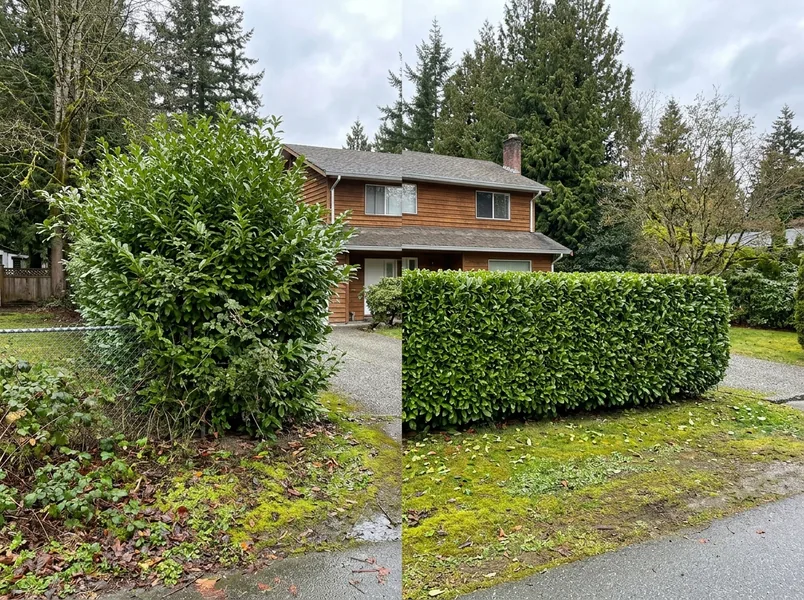
Western redcedar dieback is a progressive condition in which the foliage of cedars gradually loses colour, turning brown or grey from the inside out. Unlike a tree that dies suddenly from disease or storm damage, dieback is often a slow process that can take months or even years to fully manifest. Homeowners in Surrey frequently notice the problem when they see dead branches deep within the canopy, or when entire sections of a hedge lose their needles while other parts remain green.
The condition gets its name from the characteristic pattern of branch death that begins at the top and outer edges of the tree, then progresses downward and inward. In hedges, this can create an unsightly patchwork of brown and green that severely impacts the appearance of your property. Many people assume their cedar is diseased or dying from a pest, but dieback is usually caused by a combination of environmental stress factors rather than a single pathogen.
Why Cedar Trees Turn Brown in the Lower Mainland
The most common cause of cedar dieback in the Lower Mainland is drought stress combined with poor drainage or waterlogged soil conditions. While this may sound contradictory, cedars are sensitive to both extremes. During hot, dry summers, shallow-rooted trees struggle to access moisture in compacted or clay-heavy soil. At the same time, cedars planted in areas with poor drainage can develop root rot, which cuts off the tree's ability to absorb water and nutrients even when moisture is present. This double bind is particularly acute in Surrey, where summer temperatures can spike quickly and many properties sit on heavy clay soils.
Winter damage is another significant factor. Western redcedar is naturally adapted to the Pacific coast's maritime climate, but freezing temperatures combined with dry winds can desiccate the foliage, especially on exposed sites. When the ground freezes, the roots cannot draw water, yet the needles continue to lose moisture to the air. By spring, the tree may show extensive browning that developed during the dormant season. Salt spray from roads and de-icing salts can also accumulate on foliage and damage needles, particularly on hedges planted near driveways or streets.
Cedar Drought Stress and Summer Watering Mistakes
Many homeowners believe that established cedars do not need supplemental watering in summer, but this assumption often leads to dieback. Cedars have relatively shallow root systems compared to other conifers, which means they depend on consistent moisture in the upper soil layers. During extended dry spells or heat waves, even mature trees can suffer if rainfall is sparse. The key to preventing drought stress is to water deeply and infrequently, rather than daily sprinkles that only wet the surface.
Proper summer watering for cedars in Surrey means applying water slowly to the root zone, allowing it to penetrate 15 to 20 centimetres into the soil. A soaker hose or drip irrigation system works far better than overhead sprinklers, which waste water and can promote fungal issues on the foliage. Aim to water once or twice per week during hot, dry periods, depending on rainfall and soil type. Mulching around the base of the tree with 5 to 7 centimetres of wood chips helps retain soil moisture and moderates soil temperature, reducing the stress on roots during temperature swings. Avoid watering in late evening, as this can encourage root rot in already-stressed trees.
Signs Your Cedar Is in Trouble
Early detection of cedar dieback can sometimes allow you to save the tree through improved care and targeted pruning. The first warning signs are often subtle. You may notice that needles on the interior branches are losing colour before the outer canopy shows any change. In hedges, brown patches may appear sporadically, rather than affecting the entire plant uniformly. If you gently brush your hand along a branch and needles fall away easily, or if the bark feels soft or peels away from the wood beneath, the branch is likely dead or dying.
As dieback progresses, entire sections of the crown may turn grey or reddish-brown. The tree's shape becomes irregular, with gaps and hollow areas where branches have died. At this stage, the damage is usually extensive enough that recovery is unlikely without significant intervention. If the top of the cedar is dying while the lower portions remain green, this is a classic sign of environmental stress or root problems. Some cedars develop a thin, sparse appearance overall, as though the tree is gradually fading rather than responding to a single catastrophic event. If your cedar is showing these symptoms, contact Fraser Ridge Tree Trimming at (236) 707-6867 for a professional assessment.
Can You Save a Dying Cedar?
Tree Pruning and Crown Reduction can sometimes help a cedar recover from dieback, but success depends on how much of the tree is already dead and how quickly you intervene. If fewer than 30 per cent of the branches are affected, removing dead wood and improving the tree's growing conditions may allow it to stabilize and regrow. Pruning removes the visual evidence of dieback and allows the tree to redirect energy to healthy branches. However, pruning alone cannot save a cedar that is suffering from severe root rot or prolonged drought stress.
Improving soil conditions is equally important. If your cedar is planted in clay or compacted soil, aerating the root zone and adding compost can improve drainage and encourage new root growth. In cases where the tree is waterlogged, you may need to install drainage or consider relocating the tree if possible. For hedges, selective pruning combined with improved watering can sometimes restore a reasonable appearance, even if the hedge never regains its original density. However, if more than 50 per cent of the foliage is dead and the tree shows no new growth by mid-summer, removal may be the most practical option.
When Cedar Removal Is the Best Choice
There comes a point when a cedar with advanced dieback is no longer worth saving. If the tree is mostly hollow or dead, poses a safety risk, or has been declining for several years despite your efforts to improve its health, Tree Removal is often the most sensible course of action. A dead or dying cedar can become brittle and unstable, especially during storms or high winds. Branches may fall without warning, and the entire tree could topple if the root system has deteriorated significantly.
Removing a dead cedar also eliminates the visual blight on your property and opens up space for a healthier replacement. If you choose to plant a new cedar, selecting a cultivar that is more resistant to drought and disease, and planting it in improved soil with proper drainage, can help prevent the same problem from recurring. Fraser Ridge Tree Trimming can handle Tree Removal safely and efficiently, and our crews will chip the wood and clean up the site so your yard is ready for replanting. Stump grinding is also available if you want to reclaim the full planting space.
Looking for a professional in Surrey? Fraser Ridge Tree Trimming responds quickly for all your tree trimming needs.
Get a free estimateOur services : Tree Removal · Tree Trimming · Tree Pruning & Crown Reduction