Understanding Windthrow: Why Trees Fall Over Instead of Breaking
When a severe windstorm sweeps through Surrey, homeowners often witness a phenomenon that seems counterintuitive: mature trees topple completely over, root plate and all, rather than snapping at the trunk. This event is called windthrow, and it represents one of the most destructive forms of storm damage in coastal British Columbia. Unlike a tree that breaks partway up the trunk due to high winds, windthrow involves the entire tree being uprooted from the ground, with the root system literally lifting out of the soil.
The mechanics of windthrow differ fundamentally from simple breakage. When wind pressure exceeds the lateral strength of the tree's anchorage system, the root plate pivots upward like a lever. The tree rotates at its base until the roots lose their grip on the earth, and the whole specimen falls. This is particularly common in the Lower Mainland after winter windstorms, where gusts can exceed 80 kilometres per hour and saturated soil conditions create the perfect conditions for uprooting.
Saturated Soil: The Primary Culprit Behind Root Plate Lifting
Saturated soil is the invisible enemy of tree stability. When rainfall is heavy or persistent, as it often is during British Columbia's wet winter months, soil becomes waterlogged and loses much of its structural integrity. Soil that is fully saturated contains water in every pore space, which dramatically reduces friction between soil particles and weakens the mechanical bond that anchors roots in place. A tree that has stood firmly for decades can suddenly become vulnerable to windthrow when the water table rises and soil remains waterlogged for extended periods.
The relationship between soil saturation and root plate failure is direct and measurable. Dry soil can provide tremendous lateral resistance to tree movement, but saturated soil offers only a fraction of that support. When a windstorm arrives while soil is still waterlogged from earlier rainfall, the risk of windthrow increases exponentially. This is why tree removal services in Surrey see a spike in emergency calls following winter storms, particularly when those storms are preceded by several days of rain. The combination of heavy precipitation followed by high winds creates conditions where even healthy, well-established trees may be uprooted.
Winter Windstorms and Coastal Tree Damage in the Lower Mainland
The lower mainland experiences some of North America's most severe winter windstorms, and the geography of the region makes trees particularly vulnerable. Coastal areas and exposed locations amplify wind speeds, and trees that have evolved in sheltered valleys may have shallower root systems than those adapted to consistently windy environments. When a major windstorm strikes, the combination of exposure, saturated soil from winter rainfall, and trees with inadequate anchorage depth creates conditions for widespread windthrow damage.
Coastal British Columbia's maritime climate means that many windstorms are preceded by or accompanied by heavy precipitation. This timing is critical: a tree fell over in Surrey last winter not simply because of wind, but because that wind arrived when the soil was already saturated from days of rain. Trees uprooted after storm events are among the most common emergency calls Fraser Ridge Tree Trimming receives. Homeowners who witness a tree uprooted after storm damage should contact a professional arborist immediately, as fallen trees can pose hazards to property, power lines, and neighbouring structures. Call (236) 707-6867 for 24/7 Emergency Tree Removal services.
Identifying Hazardous Trees Before They Fall
Not every tree that falls during a windstorm comes as a complete surprise. Many hazardous tree conditions can be identified by trained arborists before a storm event occurs. Trees with shallow root systems, those that have been topped or pruned incorrectly in the past, specimens growing in poor soil conditions, or trees that are already leaning are all at elevated risk for windthrow. An arborist inspection can reveal structural weaknesses, root collar damage, soil compaction, and other factors that increase the likelihood of failure during high winds.
The best time to address a hazardous tree in Surrey is before the next winter windstorm arrives. Preventive measures such as tree pruning and crown reduction can reduce wind loading on the canopy, making the tree more stable during storms. Arborist reports, which document the health and structural integrity of trees, can be provided to your insurance company and are often required by the City of Surrey before a tree removal permit is issued. A certified arborist can assess your trees and recommend whether removal, pruning, or monitoring is the most appropriate course of action.
When Emergency Tree Removal Is Necessary
After a windstorm, a tree uprooted after storm damage becomes an immediate safety concern. A fallen tree with its root plate exposed can damage underground utilities, block driveways and roads, crush structures, or fall onto power lines. In these situations, emergency removal cannot wait for a scheduled appointment. Fraser Ridge Tree Trimming provides 24/7 Emergency Tree Removal throughout Surrey, responding to storm damage calls day and night.
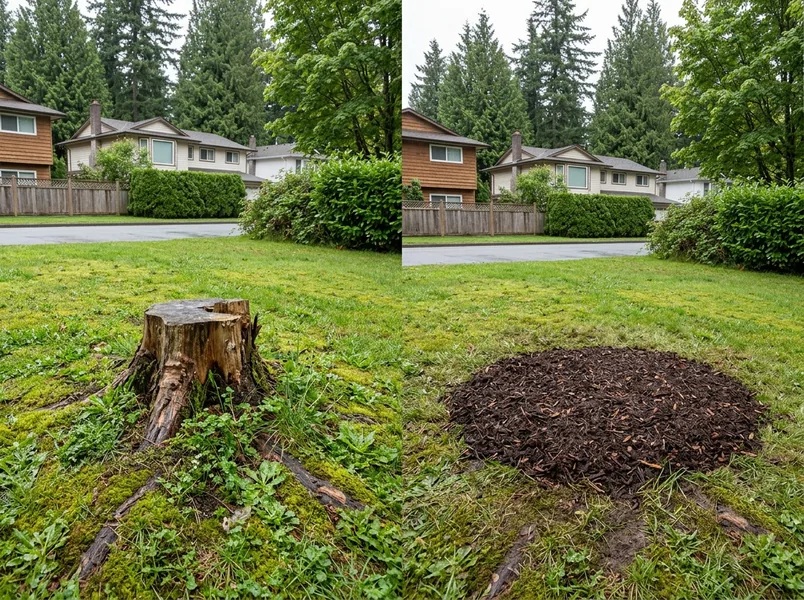
Emergency removal of a windthrow victim is more complex than standard tree removal. The root plate, soil, and exposed roots must be carefully managed to avoid further damage to surrounding property. Heavy equipment may be required to safely dismantle a large fallen tree and remove the stump. Documentation of the damage is important for insurance claims, so it is wise to take photographs before work begins. If you experience a tree falling over in your yard, contact Fraser Ridge Tree Trimming at (236) 707-6867 immediately. Our crews are equipped to handle windthrow removal safely and efficiently, and we can provide the documentation your insurer requires.
Prevention and Long-Term Tree Health
While windthrow cannot always be prevented, the risk can be reduced through proactive tree care. Regular Tree Trimming and pruning remove dead branches, reduce excess crown weight, and improve air flow through the canopy, all of which decrease wind resistance and lateral stress on the trunk and roots. Trees with balanced crowns and healthy branch structure are more stable than trees with unbalanced or dense foliage. Additionally, maintaining healthy soil around trees, avoiding soil compaction, and ensuring adequate drainage reduce the likelihood of waterlogging and root rot.
Arborists also use techniques such as cabling and bracing for trees that show structural weakness but are otherwise valuable to retain. These methods provide additional lateral support and can prevent failure during high winds. If you are concerned about the stability of trees on your property, particularly after observing trees uprooted after storm events in your neighbourhood, request a professional arborist evaluation. Fraser Ridge Tree Trimming can assess your trees, discuss your options, and provide a free estimate for any recommended work. Contact us at (236) 707-6867 or visit surrey-tree-trimming.ca to schedule a consultation today.
Looking for a professional in Surrey? Fraser Ridge Tree Trimming responds quickly for all your tree trimming needs.
Get a free estimateOur services : Tree Removal · Tree Trimming · Tree Pruning & Crown Reduction